The War in Gaza
-
Israel is not fighting a just war in Gaza. It’s brutal, it’s disproportionate, and it demands immediate attention from politicians, commentators, and citizens alike. Financial support for Israel should not be unconditional, and pressure must be put on Israel to wage a focused war with minimum civilian harm.
Additionally it’s worth noting that strong evidence exists, some of which I cover in this article, that suggests Israeli leadership supports ethnic cleansing policies. Essentially, that Israeli leadership supports the mass displacement of Gazans to nations outside of Gaza, with the implied goal of one day transforming Gaza into a Jewish majority part of Israel. It’s important that we, the American people, and the international community, maintain a steady watch on this conflict to ensure that doesn’t happen. As the Trump Administration said in their 20-point plan: the people of Gaza have suffered enough. It’s time to bring this war to an end and build a safe, terrorism free Gaza for the Palestinian people of Gaza.
-
A ceasefire has been agreed upon by Israel and Hamas as part of President Trump’s 20-point peace plan. All Israeli hostages have been returned to Israel by Hamas, except one who is known to be deceased. Efforts are ongoing to return the final hostage. Phase 1 of Trump’s plan, which involved the hostage returns and a partial Israeli withdraw, is almost completed. However, flashes of fighting continue with multiple recorded incidents of Israel and Hamas violating the ceasefire. Netanyahu is set to meet with Trump on December 29th to discuss details of the second phase, which includes Hamas disarmament, withdrawal timelines, deployment of a multinational security force, and formation of a non-Hamas civilian authority. Uncertainties remain about Hamas’s willingness to cooperate, leaving the viability of the plan in question. Netanyahu has warned that a failure by Hamas to accept the plan will lead to “resumption of full military operations.”
In this Topic Report we cut to the center of the most controversial conflict of our time to uncover the truth hidden beneath the narratives. To build out this record we’ll debunk or provide evidence for the three main narratives being pushed:
Israel has no right to exist and Hamas is fighting a just war of liberation.
Israel is committing genocide.
Israel is fighting a just war of self defense.
Where we are:
Before we dive into the narratives, let’s quickly get our bearings. Gaza is located along Israel’s coast and borders Egypt to the southwest. Below is a map providing valuable context:
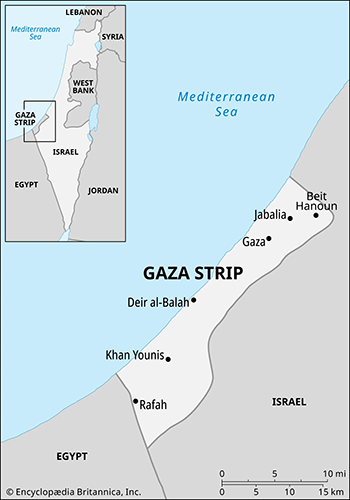
Map credit: Encyclopædia Britannica, Inc.
Narrative 1: Israel has no right to exist and Hamas is fighting a just war of liberation.
Now let’s start with the most extreme narrative that’s pushed. This narrative is important to cover for two reasons:
It’s the narrative pushed by Hamas.
It’s the narrative that can be tempting to fall into if the situation isn’t understood, and you find fault with Israel’s military operations.
But it’s simply not true. Israel declared independence in 1948 following British withdrawal. The British had occupied the territory since WWI when they captured it from the Ottoman Empire. During the period of British occupation Britain supported building a Jewish homeland in the region, leading to the Jewish percentage of the population in Palestine exploding from ~9% at the end of WW1 to ~30% by the end of WW2. This led to conflict between the Arab and Jewish populations, with Palestinian Arabs being concerned they would be pushed from their lands. After WW2 the UN proposed a solution: the formation of a Jewish state, and a Palestinian Arab state. Both nations would receive about the same amount of territory (While Jews were the minority of the population, the UN gave them slightly more than half of the region in the deal to ensure major Jewish settlements were connected. A significant portion of the Jewish state in this deal was uninhabitable desert, refuting claims the deal was unfair.) with the Jewish state receiving the major Jewish settlements and the Arab state receiving the primarily Palestinian settlements. Jewish leaders accepted the deal, Arab leaders rejected it. This started a civil war between Jews and Arabs leading to British withdrawal and Israeli independence. Israel’s independence declaration sparked a regional war which resulted in Israeli victory (Without significant western foreign aid despite common assumptions) and the Palestinian people ended up without control of any part of Palestine (They would have received 45% of Palestine in the UN deal).
A debate can be had about whether or not Britain should have governed over Palestine following WWI, and whether it should have allowed Jewish migration and supported the creation of a Jewish state. But with over 7 million Jews now living in Israel, 77 years since independence, and Jews making up ~50% of the population of Israel and Palestine combined, modern day Israel is not responsible for the actions of the 20th Century British. In 1948, when they declared independence, Israeli leaders were taking actions to protect and secure a future for over half a million Jews who were already established in the region.
In summary, present day Israel is a firmly established nation responsible for millions of citizens. It came into existence through what was arguably flawed immigration policy and the efforts of Jewish leaders with a vision of building a homeland in their ancestral land. But it’s crystal clear none of that eliminates Israel’s right to exist and protect it’s people.
The facts we’ve covered also make it clear that modern day Hamas and the Palestinian people have no right to the land of Israel. By the time there was a significant Jewish population, and they deserved the right to a nation equally as much as the Palestinian population did, a deal was offered by the UN to peacefully form a Palestinian state nearly equal in size to the Jewish one (The proposed Palestinian Arab state actually contained a large majority of Palestine’s fertile agricultural land and the largest population centers). Jewish leaders accepted this deal while Palestinian leaders rejected this deal and chose war. A strong argument can be made that at that time, before Israel was an independent nation, Palestinian leaders had a moral right to wage war if they felt that their majority and the nature of British colonial rule gave them a right to govern over Palestine. Is this not what our founding fathers believed when they laid out the following in our Declaration:
“That to secure these rights, Governments are instituted among Men, deriving their just powers from the consent of the governed, —That whenever any Form of Government becomes destructive of these ends, it is the Right of the People to alter or to abolish it, and to institute new Government, laying its foundation on such principles and organizing its powers in such form, as to them shall seem most likely to effect their Safety and Happiness.”
It is ultimately the fundamental right of any people to throw off its government if it feels there is significant cause and injustice. In 1940s Palestine the Palestinian people had a good argument for this. Britain refused to create a Palestinian legislature and allow, at the national level, self governance and representation. Our founders faced this same injustice. So when Arab leaders rejected the UN deal in 1947 they had good cause. However, in the first Arab-Israel war (1948-1949) the Palestinians lost. Years of conflict ensued leading to the current day condition of the region, with Palestinian populations largely residing in the West Bank and Gaza and Israel being overwhelmingly Jewish. Without a population majority in Israel, modern day Palestinians lack the same justified cause they had in 1947. Palestinians now have a strong cause to form a Palestinian state within Gaza and the West Bank where they do have an overwhelming population majority, but that’s not the aim of Hamas who has declared it’s mission is to destroy Israel and has carried out a constant stream of cross border attacks against Israel. These include the October 7th attack which resulted in the deaths of at least 1,200 Israelis, the majority of which were civilians. A full timeline of the October 7th Hamas attack can be found here.
Narrative 1 Conclusion:
Palestinians no longer have the same land claim that they did in 1947 when they rejected the UN two state deal. And Gaza’s government, Hamas, is not working to secure liberty and prosperity within the region they reside in, they’re working to destroy Israel. Israel came into formation through British policies which some may disagree with, but by the time Israel declared independence in 1948 the significant Jewish population had a right equal to that of the Palestinians to form a national government for themselves. A war ensued following Israeli independence resulting in the defeat of Palestinian factions and their withdrawal to Gaza and the West Bank. Israel is now a Jewish majority nation (~74% Jewish) with an established government, borders, and a moral right to defend its citizens and future. Gaza is a Palestinian majority region (~100% Palestinian) with an established government, borders, and a moral right to defend its citizens and future. But again, Gaza’s government, Hamas, does not possess a policy of defense, peace, and progress within their own borders, their policy is to destroy Israel making negotiation and progress towards Palestinian statehood under their leadership nearly impossible.
Narrative 2: Israel is committing genocide.
This is a popular narrative pushed by the UN and other NGOs. To begin to understand this argument we need to understand what a genocide really is. For our purposes we’ll use the definition agreed upon by the UN General Assembly in its 1948 Genocide Convention, which established genocide as a war crime under international law. It defines genocide as acts committed with intent to destroy, in whole or in part, a national, ethnic, racial, or religious group. The 5 acts it lays out are:
Killing members of the group.
Causing serious bodily or mental harm to members of the group.
Deliberately inflicting conditions of life intended to bring about the group’s physical destruction in whole or in part.
Preventing births within the group.
Forcibly transferring children of the group to another group.
International courts have since clarified what “in part” means. To meet the threshold of genocide, acts must be done with the intent to destroy a significant part of the group. Significance is determined in two ways:
Quantitatively: a significant proportion of the population of the group.
Qualitatively: a significant proportion of crucial members of the group, such as leaders, childbearing age women, and essential professionals.
Intent is also specifically defined in international law. Genocide requires intent to destroy a group because it is that group. This makes proving genocide difficult, which we’ll talk more about later.
To identify whether or not Israel’s actions meet the threshold of genocide, we’ll answer 4 questions:
Has Israel killed a significant amount of the civilian population?
Has Israel brought about conditions which will kill a significant amount of the population over time?
Has Israel targeted essential professionals and members of society?
Have Israel’s statements revealed the intent to commit genocide?
Question 1: Has Israel killed a significant amount of the civilian population?
Yes Israel has killed 2-3% of the population in Gaza, with at least 60,000 dead. The majority of those are known to be civilians (A Guardian report citing a leaked IDF database put the percentage of deaths at 83% civilian, The Patriot was unable to verify this report). These are staggering numbers considering there are ~30,000 Hamas fighters in total. They’ve done this in a number of ways. The majority of civilian deaths are due to rocket, drone, and other weapon attacks, while a minority is due to malnutrition and disease resulting from essential infrastructure destruction and insufficient humanitarian aid being allowed into the Strip by Israel. However, while there is significant evidence of mass civilian casualties due to Israel’s actions, the killing of 2-3% of the population alone doesn’t tell us whether or not these casualties are a natural biproduct of war, or part of a systemic campaign to destroy the Palestinian people in Gaza.
Question 2: Has Israel brought about conditions which will kill a significant amount of the population over time?
Yes, inadequate humanitarian aid flows into Gaza and strikes on water and sanitation infrastructure have led to mass food shortages, essential supply shortages, water shortages, and health hazards due to waste pile up. However, when talking about aid, it’s important to remember there are inherent difficulties in distributing aid within a war zone, for example 88% of UN aid trucks that came into Gaza never reached their destination due to ambush by desperate civilians, gangs, and Hamas. The American-Israeli aid distribution organization which took over for the UN’s system this year, Gaza Humanitarian Foundation (GHF), made some positive strides by ensuring aid reached civilians and not combatants, but their system of funneling civilians into just four centralized distribution sites was considered inherently dangerous and carried its own cons. GHF announced in November 2025 they are ending their operations, leaving the future of aid within the Strip uncertain. Ultimately food shortages and severe water shortages are still the reality on the ground, likely leading to hundreds if not thousands of deaths if the humanitarian crisis is not reversed. Israeli strikes on water and sanitation infrastructure have also reportedly been widespread, creating dangerous health conditions.
It’s worth mentioning that Hamas is massively responsible for the humanitarian crisis in Gaza as well. A complete and unconditional surrender, one which is entirely justified following Hamas’s October 7th attack, would bring an immediate end to the war and the humanitarian crisis. However, there is still significant evidence that Israel is intentionally using the illegal and immoral practice of leveraging civilian suffering as a means of warfare. And if conditions aren’t improved, civilian suffering will only increase as the impact of essential aid shortages and inadequate infrastructure compounds over time.
Question 3: Has Israel targeted essential professionals and members of society?
Yes. There are widespread reports of Israel targeting essential members of Gaza society, especially healthcare workers. There is significant evidence that Israel has intentionally targeted healthcare facilities, often rendering them inoperable and killing or injuring patients and healthcare workers (It’s important to keep in mind that Hamas does have a history of embedding military targets within hospitals and healthcare facilities, leaving a debate about what justifies a strike on a healthcare facility). Reports put the number of killed healthcare workers in the hundreds. And while the most recent numbers are hard to come by, hundreds of healthcare workers have also been detained by Israel over the course of the war and held without charges. This has contributed to the collapse of the Gaza healthcare system, further contributing to the narrative that Israel is leveraging civilian suffering against Hamas.
Question 4: Has Israel’s statements revealed the intent to commit genocide?
One of the crucial components of genocide is intent. If Israel isn’t motivated by the intent to destroy the Palestinians in Gaza in whole or significant part, and are instead only intending to put pressure on Hamas, their actions may meet the requirements for other war crimes but not the requirements for genocide. In order to identify genocidal intent we’ll look at 3 things:
Israel’s official goals for the war.
Statements from Israeli leadership.
Trump's 20 point plan for Gaza which Israel has agreed to.
Let’s start with Israel’s officially stated goals for the war, which come from a 5 point outline adopted by the Israeli Security Council in August, 2025:
Secure the release of all hostages taken during the October 7th, 2023 attack, including deceased hostages.
Ensure the disarming of Hamas.
Achieve the demilitarization of Gaza.
Establish Israeli security control over the Strip.
Form “an alternative civilian government that is not Hamas or the Palestinian Authority.”
Nothing here points to genocidal intent, so let’s move on to statements from Israeli leadership. One figure we’ll zero in on is Bezalel Smotrich, the right wing finance minister of Israel who was appointed by Netanyahu in 2022. Smotrich was additionally appointed as a minister within the Defense Ministry and given power over civil administration in parts of the West Bank. This appointment also gave him the ability to expand Israeli settlements within that region.
Our first quote from Smotrich came immediately following the 7 October attack, where he stated in a social media post: “Right now, one goal: Nakba! A Nakba that will overshadow the Nakba of ’48.” Nakba is a reference to the mass displacement of 700,000 Palestinians during the first Arab-Israeli war. Stating that the goal of the war is to displace Palestinians in mass isn’t inherently a sign of genocidal intent, but it is a statement in support of ethnic cleansing, the mass removal of a specific ethnic or religious group from a geographical area.
Our next quote from Smotrich comes in August 2024, when he stated that “It’s not possible in today’s global reality to manage a war — no one will allow us to starve 2 million people, even though that might be just and moral until they return the hostages,” this statement seems to make it clear that he would support the mass starvation of 2 million people, most of whom are civilians, if he had international support for it.
Next, in May 2025, Smotrich stated that “Gaza will be entirely destroyed, civilians will be sent to... the south to a humanitarian zone without Hamas or terrorism, and from there they will start to leave in great numbers to third countries," this is another statement in support of ethnic cleansing. He’s referencing Israel’s plan to create a “Humanitarian city” within Gaza where Gaza’s population would be brought, not allowed to leave, and encouraged to migrate outside of the Strip. This plan has been buried following intense international backlash.
One last quote we’ll examine is one from Netanyahu where he is reported, during a closed door meeting with the Knesset’s (Israeli parliament’s) Foreign Affairs and Defense Committee, to have said “We are destroying more and more houses [In Gaza]… they have nowhere to return. The only obvious result will be Gazans choosing to emigrate outside of the Strip.” He went on to say “our main problem is finding countries to take them in.” While important context is missing in his reported statement, this quote seems to show his support for ethnic cleansing policies.
Let’s move on to President Trump’s 20-point plan for Gaza, which he announced in September during a joint press conference with Netanyahu. This plan was endorsed by Netanyahu, and represents, with caveats we’ll touch on in a moment, Israel’s currently stated long term goal for Gaza. The full plan can be read here. A number of crucial points stand out:
Gaza will be redeveloped for the benefit of the people of Gaza, who have suffered more than enough.
No one will be forced to leave Gaza, and those who wish to leave will be free to do so and free to return. We will encourage people to stay and offer them the opportunity to build a better Gaza.
Israel will not occupy or annex Gaza. As the ISF (International Stabilization Force, Trump’s planned multinational security force which will serve as the long-term internal security solution within Gaza) establishes control and stability, the Israel Defense Forces (IDF) will withdraw based on standards, milestones, and timeframes linked to demilitarization that will be agreed upon between the IDF, ISF, the guarantors, and the Unites States, with the objective of a secure Gaza that no longer poses a threat to Israel, Egypt, or its citizens. Practically, the IDF will progressively hand over the Gaza territory it occupies to the ISF according to an agreement they will make with the transitional authority until they are withdrawn completely from Gaza, save for a security perimeter presence that will remain until Gaza is properly secure from any resurgent terror threat.
While Gaza re-development advances and when the PA reform program is faithfully carried out, the conditions may finally be in place for a credible pathway to Palestinian self-determination and statehood, which we recognize as the aspiration of the Palestinian people.
Netanyahu supports this plan, despite refusing the idea of Palestinian statehood, which could put the plan in jeopardy long term. The Knesset has also passed a symbolic motion endorsing Trump’s plan. On the surface this shows support for Gaza reconstruction and granting Palestinians the freedom to come and go from the Strip, a policy that aligns with neither genocide nor ethnic cleansing. However, it’s important to remember that actions speak louder than words, and it’s possible that Netanyahu is using the plan as a political tool, knowing Hamas is unlikely to accept the plan in full.
Narrative 2 Conclusion:
So is Israel committing a genocide? As we’ve covered, significant evidence exists to support this narrative. There is no question that Israel is waging one of the most brutal and inhumane wars of the 21st century, tens of thousands of civilians have died, essential aid has been restricted, cities have been leveled, and critical infrastructure has been destroyed. Far too much damage has been done to civilian infrastructure and wellbeing to make a convincing argument that Israel is fighting a purely just war of self defense, which is our third narrative.
However, there is some nuance here. As we’ve touched on, genocide, from an international law standpoint, requires specific intent to destroy a national, ethnic, racial, or religious group, because it is that group. Genocide is not just inflicting suffering or harm on a group to leverage civilian suffering against a military target, for example. To legally be charged with genocide there must be explicit statements in support of genocide, a plan or policy calling for genocide, or actions which can only be explained by having the intent to destroy a group for the sake of it being that group. We were unable to find conclusive evidence of any of those three things, which may lead to Israel and its leaders escaping formal genocide charges long term.
The fact that I’m having to dive into the minutia of what a genocide is from a legal perspective tells you a lot. The evidence that Israel is inflicting mass suffering and causalities on the people of Gaza, far beyond what should be necessary to combat Hamas, is abundant and well documented. And even without conclusive evidence of legally defined genocide, we believe the information we have covered here is sufficient to paint a portrait of the reality inside Gaza, and the character of Israeli leadership.
So, once again, is Israel committing genocide? If you’re using the term genocide to mean “brutally and unjustly killing a lot of people” then yes, Israel is committing a genocide. If you use the term as it’s defined by international law, strong evidence exists that says yes, they are. But deeper investigation by the international intelligence and law communities will be required to draw a definitive conclusion.
Narrative 3: Israel is fighting a just war of self defense.
As we’ve already debunked this narrative while investigating the last narrative, I’ll keep this short. In our first narrative we covered how Israel has a right to exist, and has a right to wage war against Hamas following Hamas’s October 7th attack. I’m not contradicting that here, Israel is justified to fight a war. However, available evidence, which we covered in the last narrative, makes it clear they have not fought a just war. Israel have done good things since October 7th, they have crippled Hamas, a genuine and dangerous terrorist organization, by eliminating many of its leaders and crushing its infrastructure. Israel has also dealt serious damage to Hezbollah, a terrorist organization in Lebanon aligned with Hamas through Iran, which funds and trains both organizations. But the extent of suffering inflicted on the civilian population prevents us from labeling this conflict as a purely just war.
Conclusion:
The bottom line of this complex and often divisive issue is this: Israel is not fighting a just war in Gaza. It’s brutal, it’s disproportionate, and it demands immediate attention from politicians, commentators, and citizens alike. Financial support for Israel should not be unconditional, and pressure must be put on Israel to wage a focused war with minimum civilian harm.
Finally, it’s worth noting that strong evidence exists, some of which I’ve covered in this article, that suggests Israeli leadership supports ethnic cleansing policies. Essentially, that Israeli leadership supports the mass displacement of Gazans to nations outside of Gaza, with the implied goal of one day transforming Gaza into a Jewish majority part of Israel. It’s important that we, the American people, and the international community, maintain a steady watch on this conflict to ensure that doesn’t happen. As the Trump Administration said in their 20-point plan: the people of Gaza have suffered enough. It’s time to bring this war to an end and build a safe, terrorism free Gaza for the Palestinian people of Gaza.
Current Status (8th December, 2025):
A ceasefire has been agreed upon by Israel and Hamas as part of President Trump’s 20-point peace plan. All Israeli hostages have been returned to Israel by Hamas, except one who is known to be deceased. Efforts are ongoing to return the final hostage. Phase 1 of Trump’s plan, which involved the hostage returns and a partial Israeli withdraw, is almost completed. However, flashes of fighting continue with multiple recorded incidents of Israel and Hamas violating the ceasefire. Netanyahu is set to meet with Trump on December 29th to discuss details of the second phase, which includes Hamas disarmament, withdrawal timelines, deployment of a multinational security force, and formation of a non-Hamas civilian authority. Uncertainties remain about Hamas’s willingness to cooperate, leaving the viability of the plan in question. Netanyahu has warned that a failure by Hamas to accept the plan will lead to “resumption of full military operations.”